
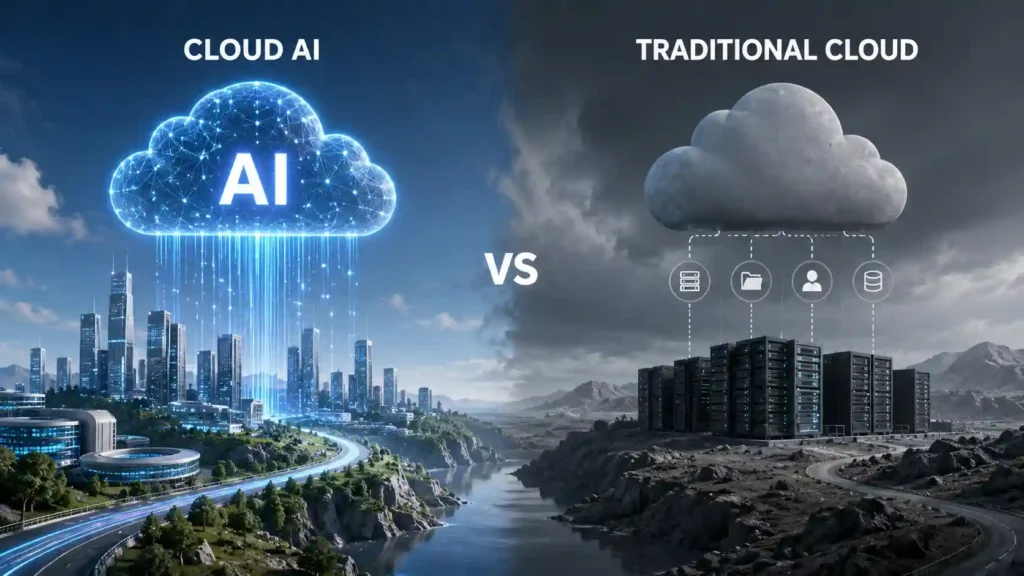
Cloud AI vs Traditional Cloud: Technology is evolving faster than ever, and businesses are continuously searching for smarter ways to improve efficiency, reduce costs, and make better decisions. Cloud computing has already transformed the way companies store data, manage applications, and scale operations. Now, a new evolution is taking place with Cloud AI.
While Traditional Cloud focuses mainly on infrastructure, storage, and computing resources, Cloud AI adds intelligence, automation, and predictive capabilities to cloud environments. Many businesses are now shifting toward AI-powered cloud solutions to stay competitive in a data-driven world.
Understanding the difference between Cloud AI and Traditional Cloud is important for businesses, professionals, and even students who want to stay updated with modern technology trends. In this blog, we will explore the major differences, advantages, and real-world applications of both technologies in a simple and user-friendly way.
What is Traditional Cloud?
Traditional Cloud refers to cloud computing services that provide infrastructure, storage, networking, and computing power over the internet. Instead of maintaining physical servers and hardware, businesses can use cloud platforms to host applications, store files, and manage databases remotely.
Traditional cloud services are commonly divided into three categories:
- Infrastructure as a Service (IaaS)
- Platform as a Service (PaaS)
- Software as a Service (SaaS)
Popular traditional cloud providers include services from companies like Amazon Web Services, Microsoft Azure, and Google Cloud.
Key Features of Traditional Cloud
- Online data storage
- Scalable infrastructure
- Virtual machines and hosting
- Backup and disaster recovery
- Remote accessibility
- Cost-effective resource management
Traditional cloud systems are excellent for hosting websites Cloud AI vs Traditional Cloud, storing files, managing applications, and supporting business operations. However, they mainly rely on manual configurations and human decision-making.
What is Cloud AI?
Cloud AI combines artificial intelligence technologies with cloud computing infrastructure Cloud AI vs Traditional Cloud. Instead of simply storing and processing data, Cloud AI systems can analyze information, recognize patterns, automate tasks, and generate intelligent insights.
Cloud AI uses technologies such as:
- Machine Learning (ML)
- Natural Language Processing (NLP)
- Predictive Analytics
- Computer Vision
- AI Automation
- Deep Learning
By integrating AI into cloud platforms, businesses can create smarter applications and automate complex workflows without building expensive AI infrastructure from scratch.
Key Features of Cloud AI
- Intelligent automation
- Predictive analytics
- AI-powered decision-making
- Real-time data processing
- Smart recommendations
- Self-learning systems
Cloud AI helps businesses move beyond basic cloud services and enter an era of intelligent operations and advanced automation.
Cloud AI vs Traditional Cloud – Major Differences
Understanding the core differences between Cloud AI and Traditional Cloud can help organizations choose the right technology based on their business goals.
1. Purpose and Functionality
Traditional Cloud mainly focuses on providing infrastructure, storage, and computing resources Cloud AI vs Traditional Cloud. Its goal is to help businesses run applications and manage digital operations efficiently.
Cloud AI, on the other hand, focuses on intelligence and automation. It processes data and learns from it to improve business decisions and automate operations.
Example
- Traditional Cloud stores customer data.
- Cloud AI analyzes customer behavior and predicts future purchasing trends.
2. Data Processing Capability
Traditional cloud systems process data based on predefined instructions and manual configurations. The system performs tasks exactly as programmed Cloud AI vs Traditional Cloud.
Cloud AI can analyze large amounts of data, identify patterns, and generate insights automatically. It continuously improves its performance using machine learning algorithms.
Example
A traditional cloud system may generate monthly reports manually, while Cloud AI can automatically detect sales trends and provide future forecasts.
3. Automation Level
Traditional Cloud requires human involvement for monitoring, maintenance, and optimization.
Cloud AI introduces intelligent automation. AI systems can automate repetitive tasks, reduce manual work, and improve operational efficiency.
Example
- Traditional Cloud: Manual server monitoring
- Cloud AI: AI automatically detects and fixes performance issues
4. Decision-Making Ability
Traditional cloud platforms provide data access but do not make decisions Cloud AI vs Traditional Cloud.
Cloud AI systems can analyze information and assist businesses in making smarter decisions through predictive analytics and recommendations.
Example
E-commerce platforms using Cloud AI can recommend products to customers based on browsing history and purchasing behavior.
5. Scalability and Flexibility
Both technologies offer scalability, but Cloud AI provides more adaptive capabilities.
Traditional cloud environments scale resources when required, while Cloud AI systems can automatically optimize workloads based on usage patterns and predictions.
This makes Cloud AI more efficient for modern businesses handling large and dynamic datasets.
6. Security and Threat Detection
Traditional cloud systems provide security tools such as firewalls and access controls.
Cloud AI enhances security through intelligent threat detection and anomaly analysis. AI systems can identify suspicious activities in real time and respond faster than manual systems.
Example
Cloud AI can detect unusual login patterns and block potential cyber threats automatically.
7. Customer Experience
Traditional cloud platforms support digital services but usually depend on human interaction.
Cloud AI improves customer experiences through:
- AI chatbots
- Personalized recommendations
- Voice assistants
- Smart customer support systems
Businesses using Cloud AI can provide faster and more personalized services to their customers.
Benefits of Traditional Cloud
Even though Cloud AI is growing rapidly, Traditional Cloud still offers many important advantages.
Cost Savings
Businesses can reduce hardware and infrastructure costs.
Easy Accessibility
Users can access files and applications from anywhere.
Scalability
Resources can be increased or decreased based on business needs.
Reliable Backup
Cloud platforms provide secure data backup and disaster recovery options.
Faster Deployment
Applications and services can be deployed quickly without physical infrastructure.
Benefits of Cloud AI
Cloud AI brings advanced capabilities that help businesses become smarter and more efficient.
Intelligent Automation
AI automates repetitive business processes and reduces manual effort.
Better Business Insights
Cloud AI analyzes data and provides actionable insights for decision-making.
Improved Productivity
Employees can focus on strategic tasks instead of routine operations.
Personalized Experiences
Businesses can deliver customized recommendations and support.
Predictive Analytics
AI can forecast trends, customer behavior, and operational risks.
Real-World Applications of Cloud AI
Cloud AI is transforming multiple industries worldwide.
Healthcare
AI-powered cloud systems help doctors analyze medical reports and improve diagnosis accuracy.
E-Commerce
Online stores use AI recommendations to improve customer engagement and sales.
Banking
Financial institutions use AI for fraud detection and risk analysis.
Marketing
Digital marketers use Cloud AI for audience targeting, automation, and campaign optimization.
Customer Support
AI chatbots provide instant customer assistance 24/7.
Which One is Better?
The choice between Cloud AI and Traditional Cloud depends on business requirements.
Traditional Cloud is suitable for:
- Data storage
- Website hosting
- Application management
- Basic business operations
Cloud AI is ideal for:
- Intelligent automation
- Predictive analytics
- Smart applications
- Advanced customer experiences
- AI-driven business strategies
Many businesses today use a combination of both technologies to achieve better performance and innovation.
Future of Cloud AI
Cloud AI is expected to become a major part of future business operations. As AI technologies continue to evolve, companies will increasingly adopt intelligent cloud solutions for automation, analytics, and personalized experiences.
Industries such as healthcare, education, finance, logistics, and digital marketing are already experiencing the benefits of AI-powered cloud systems.
Businesses that adopt Cloud AI early can gain a competitive advantage through faster decision-making, improved efficiency, and smarter operations.
Traditional Cloud changed the way businesses manage infrastructure and digital services. However, Cloud AI is taking technology to the next level by adding intelligence, automation, and predictive capabilities.
While Traditional Cloud focuses on storing and managing data, Cloud AI focuses on understanding and learning from data. This difference makes Cloud AI more powerful for businesses looking to improve productivity, customer experiences, and decision-making.
As technology continues to advance, Cloud AI will play a major role in shaping the future of digital transformation. Businesses that understand and adopt these technologies can stay ahead in an increasingly competitive market.
For companies looking to modernize operations and embrace intelligent technology solutions, Sarbajira Software provides innovative cloud and AI-driven services tailored for modern business growth.
FAQ:
1. What is the difference between Cloud AI and Traditional Cloud?
Traditional Cloud focuses on data storage, hosting, and infrastructure Cloud AI vs Traditional Cloud, while Cloud AI adds artificial intelligence, automation, and predictive analytics capabilities.
2. What is Cloud AI used for?
Cloud AI is used for automation, machine learning, predictive analytics, chatbots, smart recommendations, and real-time business insights Cloud AI vs Traditional Cloud.
3. Is Cloud AI better than Traditional Cloud?
Cloud AI is more advanced for businesses that need intelligent automation and data-driven decision-making, while Traditional Cloud is ideal for storage and infrastructure management.
4. Can businesses use both Cloud AI and Traditional Cloud together?
Yes. Many businesses combine Traditional Cloud infrastructure with Cloud AI services to improve efficiency, scalability, and automation.
5. What are the benefits of Cloud AI?
Cloud AI offers intelligent automation, faster decision-making, predictive analytics, improved customer experiences, and increased operational efficiency Cloud AI vs Traditional Cloud.
6. Which industries use Cloud AI?
Industries such as healthcare, banking, e-commerce, marketing, logistics, and customer support widely use Cloud AI technologies.
7. Is Cloud AI secure?
Yes. Cloud AI can improve cybersecurity by detecting threats, analyzing unusual activities, and automating security responses in real time.
8. Why is Traditional Cloud still important?
Traditional Cloud remains important for hosting applications, storing data, backup solutions, and scalable business infrastructure.